

Chattogram is often sold to the world as a city of cranes, containers, and commerce. But scratch the industrial surface, and you will find a city that is old. Very old.
Long before the modern ships arrived, this was “Porto Grande” (The Great Port) to the Portuguese, a spiritual sanctuary to Sufi saints, and a battleground for empires. If you are a traveler who prefers stories over selfies, this guide is for you.
Here is how to peel back the layers of time in Bangladesh’s port city.
1. The Turtles of Wrath: Shrine of Bayazid Bostami
The Myth: Evil Spirits Trapped in Shells
On a hillock in Nasirabad lies a shrine dedicated to the famous Persian Sufi saint, Bayazid Bostami. But the real draw here isn’t just the architecture; it’s the pond.
The water is filled with hundreds of rare Black Soft-shell Turtles, known locally as Mazari. Biology says they are a critically endangered species found nowhere else in the wild. Folklore says they are Genies (Djinns).
Legend has it that these turtles were once evil spirits who incurred the wrath of the saint 1,100 years ago and were transformed into turtles as punishment. They are doomed to live in this pond for eternity. As you stand by the water, watching visitors feed them bananas and bread, the line between biology and mythology feels incredibly thin.
- Visitor Tip: It is a spiritual site, so dress modestly. The turtles are friendly (and hungry), but keep your fingers safe!
2. The British Ghost: Central Railway Building (CRB)
The Legacy: A Palace for Trains
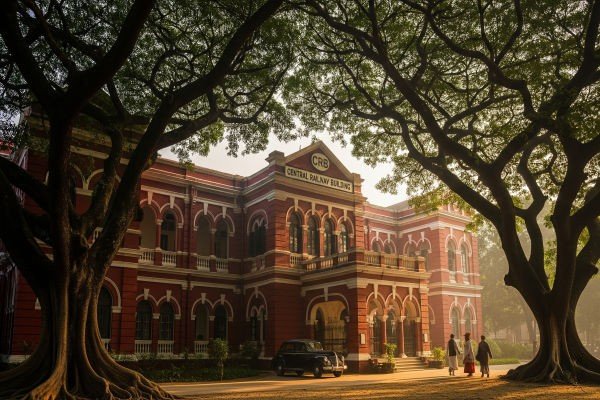
In the heart of the city, surrounded by century-old Rain Trees (Shireesh), sits a red-brick building that looks like it belongs in Victorian England. This is the CRB, built by the British in 1895 to serve as the headquarters for the Assam-Bengal Railway.
But CRB is more than just an office. It is a landscape. The area is defined by its “Seven Roads” (Shat Rastar Mor), winding through hills that feel cooler and quieter than the rest of the city. In 2025, it remains the cultural lung of Chattogram.
- The Hook: Visit during the Bengali New Year (Pahela Baishakh) to see the massive Boli Khela (traditional wrestling) that takes place nearby. It’s a raw, dusty display of strength that has happened here for over a century.
3. The Silent Soldiers: Commonwealth War Cemetery
The History: A Corner of Europe in Bengal
Hidden behind a quiet street in the Dampara area is a perfectly manicured lawn that feels worlds away from the chaos of Bangladesh. Rows of identical white headstones stand in formation, marking the resting place of over 700 soldiers from World War II.
These men came from the UK, West Africa, Canada, India, and New Zealand to fight in the Burma Campaign, only to find their final rest here. It is a sobering, peaceful reminder of Chattogram’s strategic importance in global history.
- Why Visit: It is arguably the best-maintained site in the city. The silence here is heavy and profound—a perfect place for reflection.
4. The Portuguese Echo: Firingi Bazar
The Origin: Pirates and Traders
Did you know Chattogram has a connection to Portugal? In the 16th and 17th centuries, the Portuguese were dominant here, so much so that the area where they lived is still called Firingi Bazar (Market of the Foreigners).
While most of the original structures are gone, the Catholic presence remains. The Diang settlement across the river and the old churches in the city center are faint echoes of a time when Portuguese pirates and traders ruled these waters.
5. The Lamp Hill: Cheragee Pahar
The Culture: Where Art Meets Rebellion
If you want to meet the modern soul of Chattogram, go to Cheragee Pahar (Hill of the Lamp). Legend says a Sufi saint left a lamp here to guide the city, but today, it lights up with culture.
This intersection is the unofficial headquarters for the city’s artists, poets, journalists, and rebels. The streets are lined with bookshops, small tea stalls, and flower markets. It is where the city comes to debate, paint, and drink endless cups of tea.
A Note for the Cultural Traveler
Chattogram’s heritage isn’t preserved in glass cases; it is lived in. The shrine is active, the CRB is a working office, and Cheragee Pahar is a busy intersection.
- Best Time to Explore: Early morning (6:00 AM – 9:00 AM) is magical, especially at CRB and the Shrine, before the heat and traffic kick in.
- Respect: When visiting shrines or the cemetery, silence and modest clothing go a long way in earning respect from the locals.
Step into the past. It’s waiting for you just around the corner.
0 Comment